
Thursday 14 May 2026
Last updated: Tuesday 19 May 2026

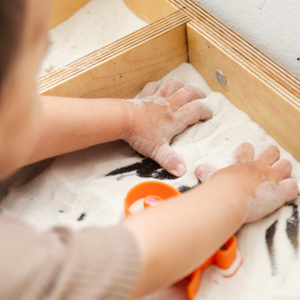
To the casual observer it may seem like your child racing around the house pretending to be a fairy is the joyous, inventive fun of a child playing and nothing more, but there’s so much happening in that moment. Children learn about themselves and the world around them through play.
When children use imaginative play, they use a specific part of the brain, that helps them think outside the box. It also helps them explore different ways they could do something.
Play provides children with the opportunity to hear and explore the power of their voice and practice using new sounds and words. Active play supports muscle development, physical, gross and fine motor skills.
Children are fascinated by the world. When they are exploring their world, they are actually playing out their experiences and how they see the world.
So, when you see children wanting to be teachers or playing in a home corner at school, they are copying what they see around them.
Children develop emotional regulation, emotional literacy and self-awareness through play. As they interact with peers, they naturally encounter moments of frustration, jealousy, excitement and joy, and these experiences help them learn to recognise and manage their feelings more effectively. Play gives them opportunities for feelings to come up naturally.
Play and social interactions form a “serve and return” between child and adult interactions which a child may have missed out on in their previous family environment. Experiences of positive play can help build and develop secure attachments, which are vital for a child’s long-term wellbeing.
Through play, children learn to solve problems, develop their language skills and social skills, fostering a love of learning, whilst developing their imagination. They develop independence, perseverance, patience, resilience, empathy and emotional intelligence.
Cognitive Development: Through play children learn to think for themselves, exercise their memory and problem solve. You can help a child build their cognitive power by playing with blocks, playing with puzzles, or playing pairing games. This may seem simple but for them, it is about understanding the world and how things fit together. This is vital for developing their cognitive skills.
Creativity Enhancement: Imaginative play is a great way for children to explore the boundaries of their imaginations. It’s not just “fun”; it’s a rehearsal space for life, a way for them to make sense of the world around them.
By creating new worlds, they’re able to practice how to adapt and work with their peers. This helps nurture their creativity and think outside the box, but it also helps them develop essential cognitive and social skills, such as problem solving, adaptivity and confidence in expressing themselves. These are all skills that they will rely on when tackling tricky schoolwork or navigating friendships and adulthood.
Emotional Growth: Children learn to express their feelings, understand emotions and develop empathy through play. They learn this through activities like caring for a doll or playing out scenarios like playing teacher, conflict and resolution or acting out a visit to the doctor. By acting out these scenarios they’re able to practice recognising emotions and how to respond, which helps strengthen their emotional intelligence and empathy for others.
Child-led play is where a child leads, and the primary carer follows. It is one of the most important forms of play for building connections and solidifying the attachment between a child and a primary carer. By playing with the child, supporting their choices and letting them lead, you help build self-esteem and independence. Confidence can also be strengthened through simple, success-based activities such as throwing a ball into a hoop or other target focused games.
Language Skills: When children engage in play, they are also working on their language skills. Whether they are interacting with other children, talking to an imaginary friend or with others during a game, they are fine-tuning their language and communication skills.
Physical Development: Running, playing hopscotch, throwing a ball; playtime is full of physical play, which is critical to a child’s development. These activities help develop their motor skills, coordination and even set the foundation for healthy habits in the future.
Social Skills: Children learn how to negotiate, cooperate, resolve conflict and understand other people’s perspectives through play. Every playdate and group game and activity is a chance for them to build their social skills.
A child may struggle to throw a ball at their friend and feel frustrated but through perseverance and determination, this moment serves as a foundation for self-regulation, hand eye coordination, communication and friendships. Children learn to map out strategies on how to use play for both fun and problem solving.
Play, when implemented as the primary focus for learning, becomes a complete curriculum for children because they learn best in a responsive setting where they can use their five senses. With the support of their caregivers, children can begin to understand and build the foundations necessary to learn mathematics, sciences and linguistics.
Play lets your child explore, experiment and take healthy risks with confidence. It challenges them without fear of failure. Games are a great way for kids to play together and develop self-esteem, improve fitness, confidence, leadership skills and team building.
Ultimately, play is an essential part of your child’s development and by making space for play in a child’s daily life, you are helping them develop emotionally, socially and physically. When we play with children and watch what they do, we learn more about them.
This helps us guide, encourage and nurture them as they grow.
Take the first step to transforming a child or young person’s life today and register your interest with our carer enquiries team to join the Five Rivers family.